India's brittle energy security is inextricably linked to two opposing paradigms - fossil fuels, and the transition to green energy. The first powers the present; the second paves the way for Viksit Bharat in 2047.

The Indian government has expressed its disagreement with the IMF staff's 'baseline' assumption that the 50 per cent US tariffs on its goods exports 'would remain in place indefinitely', based on which the staff pegged the country's GDP growth at 6.6 per cent this year, and pared its 2026-27 projection by 20 basis points to 6.2 per cent.

Most chief ministers are in favour of the new tax regime.

Union Finance Minister Nirmala Sitharaman on Tuesday said the mass consumption items such as pulses, wheat, rice, flour, and curd will not attract the 5 per cent goods and services tax (GST) when sold loose, and not pre-packed or pre-labelled. The clarification came amid protests and widespread criticism by Opposition Members of Parliament over foisting GST on daily-use essentials and subsequent price rise. The all-powerful GST Council, chaired by the Union minister, had last month decided to impose GST on some mass consumption items to simplify the rate structure, which came into effect on Monday.
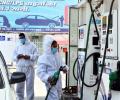
BJP leader Sushil Kumar Modi on Wednesday said it is not possible to bring petrol and diesel under the GST regime for the next eight to 10 years as it would cause an annual revenue loss of Rs 2 lakh crore to all states. Centre and states collectively collect over Rs 5 lakh crore tax on petroleum products, Modi told the Rajya Sabha while participating in a discussion on the Finance Bill 2021. The statement assumes significance in view of the rise in petrol price for the past over one year which even touched Rs 100 per litre in some states. In the first reduction in rates in over a year, petrol price on Wednesday was cut by 18 paise per litre and diesel by 17 paise a litre as international oil prices tumbled to the lowest since early February.
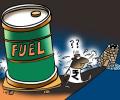
Bringing petrol, diesel and other petroleum products under the single nation-wide GST regime will reduce taxes on these products and increase the revenue of both the Centre and states, Union Minister Nitin Gadkari said on Wednesday. Finance Minister Nirmala Sitharaman will definitely try to bring petrol and diesel under GST if she gets the support of the state governments, said Gadkari while addressing the Times Now Summit virtually. "In the GST Council, finance ministers of states are also members.
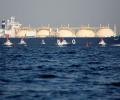
The government should bring natural gas under the Goods and Services Tax (GST) regime to realise Prime Minister Narendra Modi's vision for a gas-based economy and raising the share of the environment-friendly fuel in India's energy basket, an industry body that represents the likes of Reliance Industries as well as state-owned firms, has said. Natural gas is currently outside the ambit of GST, and existing legacy taxes -- central excise duty, state VAT, central sales tax -- continue to be applicable on the fuel. In its pre-Budget memorandum to the finance ministry, Federation of Indian Petroleum Industry (FIPI), which boasts of members from across the oil and gas spectrum, also demanded rationalisation of GST on transportation of natural gas through pipeline as well as on re-gasification of imported LNG to help bring down cost of the environment friendly fuel.

The best course for the government at this time would be to tighten the seat belt a little more, without compromising on its investments in creating better infrastructure and giving a push to privatisation, points out A K Bhattacharya.
No longer a discretion of the tax administrator, the audit of returns filed by taxpayers is now based on a selection by algorithms, notes Tarun Bajaj.
The GST Council on Saturday postponed a decision on cutting tax rate on life and health insurance premiums, officials said. The 55th meeting of the GST Council, chaired by Union Finance Minister Nirmala Sitharaman and comprising state counterparts, decided that some more technicalities needed to be ironed out and tasked the GoM for further deliberations.
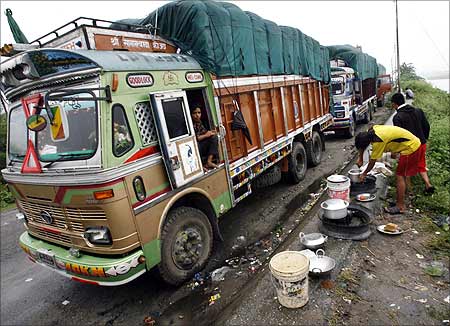
Taiwan in 1951 came up with an ingenious plan to improve tax compliance: citizens taking receipts for purchases could use them as lottery tickets. Customers were incentivized, and businesses found it hard to evade taxes. The plan's success prompted other countries, Slovakia and Greece among them, to launch similar initiatives. India doesn't seem to find the need yet for such schemes amid surging goods and services tax (GST) collections.
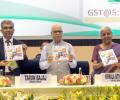
'We revolutionised the system in a manner so that the chances of leakage will be much lower than it was in the beginning.'

In the year-long crackdown on tax evasion, the GST authorities have unearthed over Rs 35,000 crore of tax fraud committed by misuse of input tax credit provision under the Goods and Services Tax (GST) regime. During the 2020-21 financial year, the CGST zones and the Directorate General of GST Intelligence (DGGI) booked about 8,000 cases involving fake ITC of over Rs 35,000 crore, a statement from CBIC said. Under the GST regime, at the time of paying tax on output, entities can reduce the tax they have already paid on inputs.

Annapoorna chain of restaurants owner Srinivasan is seen purportedly highlighting concerns over varying GST rates. In the second video, Srinivasan was seen purportedly apologising in person to the Finance Minister.
In October 2024, Jindal Stainless challenged a Goods and Services Tax (GST) notice in the Delhi high court. It was about corporate guarantees issued to related parties by its former group company, Jindal Stainless (Hisar), before their merger in March 2023.

'We have now drastically simplified it, primarily to two rates in long-term capital gains: 20% and the applicable rates. Similarly, in short-term capital gains.' 'For listed shares, there is a slight increase, but for unlisted shares, where indexation benefits are removed, there is a reduction in rates, benefiting unlisted companies, venture capital firms, etc.' 'Similarly, in real estate, wherever returns are higher, the new structure is beneficial. In very few cases, returns are lower, and those are more of an exception.'

A road map could be laid out for a gradual reduction in the tax rates from the current incidence of about 62-94 per cent without causing a major blow to the revenues of the Centre and the states. The opportunity arising out of higher GST collections should not be squandered, says A K Bhattacharya.

Prime Minister Narendra Modi on Wednesday asked the Congress to tell the nation who prevented India's military response after the 26/11 Mumbai terror attacks linked to Pakistan, and accused the party of weakening the fight against terrorism when in power.
.jpg)
The GST Bill, introduced in Parliament in 2010, is being vetted by the Standing Committee on Finance. Now, the states and the Centre would together finalise the draft and bring it back to Parliament.
The large drop was for export orders that were meant to be delivered until October.
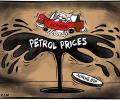
Many states are open to the idea of petrol and diesel being brought under the goods and services tax (GST) regime - contrary to the perception that they are averse to it - but they want a concrete proposal, including a compensation mechanism, from the Centre. West Bengal Finance Minister Amit Mitra says while the issue can be discussed, the Centre may not be keen to bring the change because it earns "much more" from taxes on petrol and diesel. "(The peak rate of) GST is 28 per cent. Under the regime, the Centre would only get 14 per cent. "So, definitely, the Union government does not want GST on fuel. It is all lies. Currently, they are in a very cozy place," Mitra said.
The government has extended the deadline for filing GST annual return and audit report for the 2018-19 fiscal year by a month, till October 31.

Is the curated and limited data put out by the central government sufficient enough to pass a judgement on the trend in GST collections, particularly that of the Centre?

Kerala Finance Minister K N Balagopal has sought systemic changes in the GST structure, saying every state and consumer has lost because of its basically flawed architecture that has also led to rampant revenue leakage for the states. The Goods and Services Tax (GST) regime came into force in July 2017. Even though the framework is focused on having a one-nation-one-tax model, quite a few items, including petroleum products and liquor are still out of the GST purview.

The Deutsche report said though India must move to a GST regime, the transition is likely to be disruptive for large sections of the economy and SMEs

Will it benefit you? Or will it lead to an increase in inflation? Bipin Sapra believes it will be some time before GST's benefits reach consumers.

Other decisions piled up include rationalisation of GST rate slabs, correction of inverted duty on certain items and inclusion of petroleum products.
Singapore's single-rate GST structure cannot be India's model. But its practice of early announcement of rates much before their implementation should be emulated by India, says A K Bhattacharya.

The growing rift between MSIL and rival automakers has complicated the government's efforts to finalise the CAFE norms.
Can this growth in GST collection be sustained in the coming years? asks A K Bhattacharya.

The list of exempted goods from central excise duty has shrunk from 400 items in 2011-12 to 300 now.

Lack of visibility on rates makes companies apprehensive.
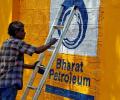
BPCL is a high revenue-earning public-sector undertaking (PSU) and plans to privatise it are completely off the table, Petroleum and Natural Gas Minister Hardeep Singh Puri said on Tuesday after assuming charge of the ministry for the second time. "Why would we divest ourselves of highly successful Maharatnas like BPCL," Puri said, arguing the Centre was not in favour of divesting its stake in oil PSUs.
'These provisions may even be seen to be a threat to burgeoning businesses, since they would view every announcement of a rate cut as a starter's pistol that triggers a long race to adjust prices and to justify the adjustment,' argue Rashmi Deshpande and Anjali Krishnan.
Expanding investigation into allegedly wrongful claims of input tax credit by insurance companies, the tax authorities are probing a section of automobile dealers who have supposedly generated fake invoices without providing any service, which is a punishable offence under goods and services tax (GST) law. The authorities are learnt to have questioned the car dealers to explain the services they provided general insurance companies. The investigators suspect car dealers pitched for insurance schemes that give them commissions in excess of those insurance regulations permit.
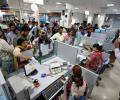
The ambiguity arose after notices were sent to lenders for non-payment of service tax under the pre-GST regime
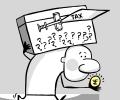
'There are unscrupulous traders who create fake invoices by showing bogus e-way bills, movement of goods.' 'Since the entities registered across different states, and kept on changing their numbers, tracing them was difficult.'

The discussions are at a very critical stage

GST rates would depend upon whether the commodity is used by a rich person or a common man
